Today, companies can draw on many valuable technology resources. However, perhaps the most obvious case is DevOps resources. This set of IT practices will allow you to work more efficiently. But which are the most successful tools? We will tell you in detail.
The best DevOps tools you need to know about
The first thing to point out is that this market is really interesting. According to a report by DZone, the DevOps market will generate about $6.6 billion by 2022. More and more organizations are implementing it at different scales, and you should be one of them.
In this sense, don’t you know what this concept means? Well, it encompasses all the practices, work philosophies, and tools that allow organizations to offer IT services in a more efficient way. By adopting this philosophy, customers can be served with quick corrections, gaining a competitive advantage in the market.
All this means that companies that incorporate this work culture, through different tools, are better able to meet their objectives. After all, they can optimize their products and services, with fast development processes. Do you want to know which are the best tools? We will tell you about them below.
Jenkins
Jenkins is an open-source automation server. But how does it help companies? Well, it’s easy: it serves to automate all software development processes. For this reason, this tool allows teams to monitor recurring tasks, integrate changes easily and identify problems quickly.
Jenkins allows you to use more than 100 plugins, which can be integrated with many current tools. This standalone program was written in Java and runs on Windows, Linux, or macOS. In addition, Jenkins can be configured via a simple web interface with integrated help.
Docker
Let’s continue with another resource that you can take advantage of. Docker is used by more than 11 million developers around the world. This tool allows you to build, package and deploy code simply and dynamically, to improve work productivity.
Docker eliminates all configuration activities, focusing on fostering team collaboration. In this sense, Docker allows developers to run in the development environment and operations teams to perform various tests and deployments.
It has several notable features in its favor. For example, Docker can use virtualization on the operating system to deliver containerized apps. In addition, it works with GCP and AWS, simplifying migration to the cloud. On the other hand, it also integrates seamlessly with other tools, such as GitHub or CircleCI.
Puppet
A puppet is an open-source tool for improving software configuration management through automation. This tool works to manage the different stages of the software lifecycle. For example, provisioning the IT structure, applying patches, and configuring software components.
Among its main features, Puppet is developed in C++, Clojure, and Ruby. For this reason, it runs smoothly on Windows, Linux, and Unix. It also uses declarative language, which is used to define the system configuration. And, to top it off, it reduces manual errors, allowing your team to scale IT infrastructure.
Apache Maven
Developed in Java, Apache Maven is used for projects that have also been created in Java. And what does it work for? Well, simple: it seeks to manage and understand projects. It helps in the construction, reporting, and documentation of the various projects.
Apache Maven has predefined targets for compiling and packaging code. You can also download Maven plugins and Java libraries so that the development process is as fast and efficient as possible. In addition, you have automatic updates and dependency closures.
Bamboo
Bamboo is also used to link builds, releases and automated testing. All in one workflow! Thanks to this tool, you can create multi-stage build plans.
You have two versions: an open source one and a paid one. If you develop an open-source project, there is no need to pay. On the other hand, for commercial organizations you’ll need to purchase subscriptions. Anyway, its intuitive user interface, auto-complete features and automation processes make it worth the investment.
Gradle
Finally, you can also take advantage of Gradle. It allows you to speed up the productivity of all software developments. Gradle is built in Java, Kotlin, and Groovy, and is used to automate different aspects of projects. For example, software development, testing, and deployment.
Gradle has a very advanced ecosystem of integrations, in addition to different plugins that allow systematizing the software delivery throughout the entire life cycle. Gradle allows scaling the development through fast builds, and it is so versatile that it can be used by large companies and also by startups.
In short, you have seen that there are many DevOps tools that you can take advantage of for your business. As you have seen, they will help you to achieve better and better results, and we hope this article has been of great help to you!
Data is a vital resource for any organization. Managing business data requires a careful and standardized process. We have already discussed in previous articles the life cycle of data and how it can help your company in making business decisions. This is why today we propose to take another step into the world of data and understand what types of data companies like yours work with.
Database management problems are often related to tight behaviors in the organization. That is to say, inconveniences with the treatment of the data that arise from the use of outdated, inefficient technologies that consume many organizational resources. This translates into a high dependency between the programs used and the data, little flexibility in administration, difficulty in sharing data between applications or users, data redundancy, and poor information security.
But even in advanced technology companies, it is common to find the same limitation: staff does not understand the types of data they are working with and have difficulty transforming the data into key knowledge relevant for decision making. And with the advancement of Big Data in companies, these problems represent a loss of value for customers, employees, and stakeholders.
Data in companies: different structures.
Everyday companies collect (and generate) a lot of data and information. With the advancement of technology, data that lacks a defined structure became accessible and of great use for making business decisions; years ago, it was almost impossible to analyze these data in a standardized and quantitative way. Let’s see what the alternatives we face are:
Structured data. They are traditional data, capable of being stored in tables made up of rows and columns. They are located in a fixed field of a specific record or file. The most common examples are spreadsheets and traditional databases (for example, databases of students, employees, customers, financial, logistics…).
Semi-structured data. These do not follow a fixed and explicit scheme. They are not limited to certain fields, but they do maintain markers to separate items. Tags and other markers are used to identify some of its elements, but they do not have a rigid structure. We can mention XML and HTML documents, and data obtained from sensors as examples. Some other not-so-traditional examples that we could mention are the author of a Facebook post, the length of a song, the recipient of an email, and so on.
Unstructured data. They are presented in formats that cannot be easily manipulated by relational databases. These are usually stored in data lakes, given their characteristics. Any type of unstructured text content represents a classic example (Word, PowerPoint, PDF files, etc.). Most multimedia documents (audio, voice, video, photographs) and the content of social media posts, emails, and so forth, also fall into this category.
How do I structure my data?
Beyond the level of structure discussed above, it is essential to your organization’s data management process that you can standardize its treatment and storage. For that, a fundamental concept is that of metadata: data about data. It sounds like a play on words, but we mean information about where data is used and stored, the data sources, what changes are made to the data, and how one piece of data refers to other information. To structure a database we have to consider four essential components: the character, the field, the record, and the file. So we can understand how our data is configured …
A character is the most basic element of logical data. These are alphabetic, numeric, or other-type symbols that make up our data. For example, the name PAUL consists of four characters: P, A, U, L.
The field is the grouping of characters that represents an attribute of some entity (for example, data obtained from a survey, from a customer data management system, or an ERP). Continuing with the previous example, the name PAUL would represent a complete field.
The record is a grouping of fields. Represents a set of attributes that describe an entity. For example, in a survey, all responses from Paul (a participant) represent one record (also known in some cases as a “row”).
Last but not least, a file is a group of related records. If we continue with Paul’s example, we could say that the survey data matrix is an example file (whether it is encoded in Excel, SQL, CSV, or whatever format it is). Files can be classified based on certain considerations. Let’s see some of them:
The application for which they are used (payroll, customer bases, inventories …).
The type of data they include (documents, images, multimedia …).
Its permanence (monthly files, annual sets …).
Its possibility of modification (updateable files –dynamic, modifiable-, historical –means of consultation, not modifiable).
As you have seen, the world of data is exciting and you can always continue learning concepts and strategies to take advantage of its value in your organization. To close this article and as a conclusion and example of the value of data for companies, we want to invite you to learn about a project in which we work for one of our clients. The General Service Survey that we develop for Aeropuertos Argentinos is an application of the entire life cycle of data (from its creation to its use) and is fed with data of different levels of structure. It is about the development of a platform to carry out surveys to visitors and employees, together with the analysis and preparation of automated reports. Don’t miss this case study!
For an organization to be competitive in the current context, it needs to be sustainable and able to anticipate paradigm shifts. Innovation and the development of solutions to exceed customer expectations must be leveraged with technologies and software that allow process optimization.
The business model of companies is currently affected by technological progress and only companies that take advantage of these developments manage to stand out from the competition. But first, we are going to understand what an information system is and how it collaborates with the operations of an organization.
What are Information Systems?
Surely you came here wanting to know what an information system really is, but first we have to understand two key concepts that make it up: Systems and Information Technology.
A System is a set of elements that are related and work together pursuing a certain common objective. A system does not necessarily consist of technological elements. We could, for example, think of an organization as a system made up of people who fulfill different roles.
Information Technology refers to all the products and software developments that are used to collect, transform, store, process, protect and retrieve data to turn it into useful information for decision-making. For this, you need both hardware and software elements, telecommunications networks and databases.
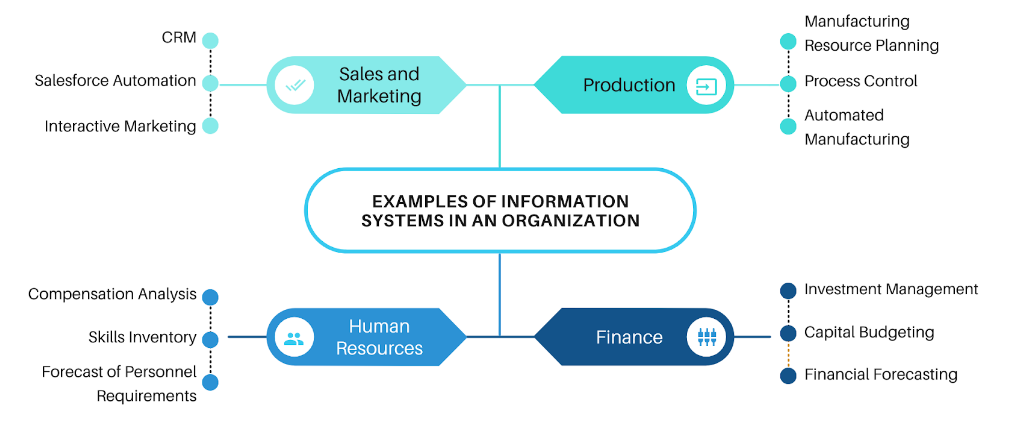
By combining these concepts we can reach an understanding of the Information Systems of organizations. We are talking about the joint work of people, systems and information technologies, whose objective is to take advantage of data and information to optimize the planning, management and control of activities.
An organization may have advanced information technology, products, and software developments, but if system components, such as people, are not properly integrated, then it may fail. Proper integration is key! That is why at Huenei we offer support in the implementation of our software developments, to ensure that our clients can take full advantage of them. Correctly designed, developed and implemented information systems can help reduce risks and uncertainties in the decision-making process and the execution of business processes in various areas. Let’s see some examples…
We’d like you to review some case studies of developments that we have carried out for some of our clients, so that you can see practical applications in different environments:
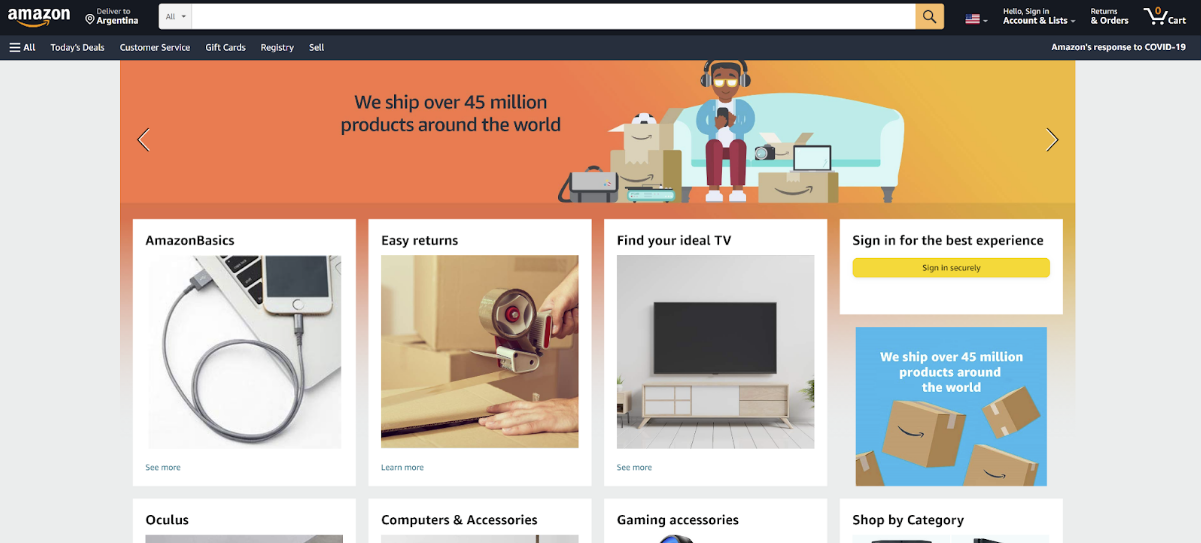
Content. What functionalities does a system offer the user?
Experience. How is the user interaction with the system?
Platform. What are the processes and infrastructure that the system needs to fulfill its functionality?
Let’s analyze these three components with the example of Amazon, considering the customer as the end user. The Amazon platform offers customers the ability to purchase products online. But other very useful functionalities are also offered, such as reviews, ratings, recommendations, search filters, among others. The experience includes both the interaction with the website, as well as the business processes with which the client is in contact (customer service, FAQs, payment gateway, etc.). Amazon focuses, from its platform, on offering an excellent experience so that the customer can find the ideal product, at the ideal time and easily. Regarding the platform, beyond the UX/UI design, the management of product and stock information, customer data and all those business processes with which the customer does not interact is key.
How Do We Design Information Systems for Our Clients?
The elements that make up an information system must be fully understood in the development of the software product when the objective is that the client can have a satisfactory implementation. That is why at Huenei we focus on three key areas when planning a software development: Organization, Management, Technological Infrastructure.
Organization. The structure of the client organization for which we are working is a fundamental input of any project. Understanding it allows us to understand priorities, roles of individuals, implicit needs of the system and areas or departments of the company that will be users of our development.
Management. After understanding the organization itself, we examine the management structure of the organization and how users will need to use it. This allows us to anticipate user interactions prior to development.
Technological Infrastructure. The technological infrastructure is made up of the hardware, software, databases and telecommunications networks necessary for the development of prototypes and final products. It is the technical instance of design, development and implementation that allows us to reach the final version of the developed product.
Once we understand the organizational structure and roles within a company, the management and usability needs, and the technological infrastructure necessary for the project, we can conceptualize the ideas and arrive at the perfect finished product for the identified needs. We invite you to learn about our step-by-step processes in our three Project modalities: Dedicated Teams, Staff Augmentation, and Turnkey Projects.
Outsourcing is a business solution based on transferring resources and responsibilities to another company dedicated precisely to the provision of those services. In the world of information technology, software outsourcing has become an increasingly common practice, due to the advantages it represents.
The outsourcing process is closely related to the growth and advances in the area of information technology and information systems of organizations, and their impact on commercial, labor and government relations. Globalization, accompanied by the shortening of physical distances and the possibility of working with teams and organizations in different countries, have contributed to the advancement of this practice in the last 20 years. Nowadays, IT services outsourcing is an important solution for companies in various sectors to leverage their services.
Software Outsourcing or In-House Solutions?
It is no longer necessary for a company to have an area for each process, or technological infrastructure, to grow. In addition to a great advantage in cost reduction, the main opportunity offered by the outsourcing of technology services is related to innovation. Companies like Huenei have teams for the ideation, design and development of custom software products to achieve the best solutions for customers.
On the other hand, in-house development often implies that the team becomes outdated with respect to the advances of the industry and the global market. This means that service providers like Huenei can offer innovative and current results that constitute a point of differentiation for client companies.
Additionally, outsourcing in software development gives companies the possibility of focusing their activities on the core of their business, without neglecting the quality of the products developed by suppliers. This is precisely what it is all about, giving the company the possibility to focuse on the development of its strategic activities, free from worrying about adjacent tasks.
Software Outsourcing Modalities
In recent years, different countries have demonstrated a certain level of specialization or mastery in the outsourcing of services in different areas. For example, the provision of financial services for America and other countries around the globe is generally focused on countries such as Mexico, Argentina, India and other Asian countries, operating under the modality of shared services. It is common to find the provision of decentralized contact center services in Colombia or Peru for Spanish-speaking markets. And it is countries like Argentina, Chile and Brazil that are characterized by offering high-level technology and software development services.
In this sense, companies can choose three approaches when selecting an outsourcing service provider based on their location: Onshore, Nearshore or Offshore.
Onshore. Basically, it refers to the contracting of technology services to a company that is located in the same country. An example of this field is a project carried out by Huenei for Aeropuertos Argentina 2000 (Argentina), which was based on the development of a passenger survey system with automatic analysis of responses and presentation of indicators on control panels.
Nearshore. This refers to companies that outsource services to organizations in countries other than their own, but which are close, either geographically, in terms of time zone, language, culture, or other relevant aspects. This generally allows for simpler adoption, less bumpy transfer of knowledge, and fewer hours of training. As an example we could mention the project carried out by Huenei for the Contraloría General de la República (Chile), where a mobile application was developed so that citizens can obtain information on public works carried out by the Government of Chile.
Offshore. Another method of outsourcing developments is Offshore, which consists of hiring the services of companies in countries other than their own, which are distant in terms of culture, geograpgy, location, language, etc. This strategy brings important advantages, like the Nearshore, but it is generally related to a greater reduction in costs, which justifies the cultural, time and language limitations in the relationship of individuals. To illustrate this alternative, we can talk about the development of a voice assistant platform that Huenei made for SoundHound (United States of America); the project consisted in the development of a voice recognition system.
As a conclusion to everything we have been discussing in this article, we can agree that the advancement of technologies and globalization led to the rapid development of the outsourcing industry. More and more companies decide to outsource different services, and software development is one of the main areas affected by this trend. Outsourcing represents great advantages for companies that need software products to achieve their objectives and leverage their business, regardless of the selected modality. If you are looking for outsourcing solutions for your organization, we invite you to learn about our Dedicated Teams, Staff Augmentation, and Turnkey Projects services, to define which is the one that best suits the needs of your project and your company.
If you think that building a product only after you have started selling it to people is a mad idea, we are here to show you great minimum viable product examples that prove the opposite.
MVPs can be any ideas or products that feature only a limited set of functions or capabilities that are still enough to prove your concept in a determined market.
Whether you are working on app development or a vegan dog-treats business, building an MVP may save you time and money on the way to commercializing a finished product, and the definition doesn’t stop there, since you can also ask yourself about minimum viable channels, segments, services or promotion.
Facebook, Dropbox, and Zappos have all in common that they started as minimum viable products, proving that investing tons of money is not always a requirement for launching a big business, but the ability to listen to your market and carefully cater to them according to their feedback of your ideas.
In this article, we will show you what the different types of MVPs are and give you examples so you can get inspired and easily venture out into the wild world of product and service development. We will also explore some minimum viable product examples.
5 Types of Minimum Viable Product Examples That You Can Build on a Low Budget
In the world of startups, it is common to see state-of-the-art tech that no one really knows what to use for. This probably happens because creators often focus on bringing finished products to the market without first considering if consumers really want them, and here’s where MVPs play a vital role in redefining business models.
Think about the overhyped Google Glasses that were about to be released in May 2014 for $1,500. The company focused so much on product features such as using a VR platform via voice commands (which sounds really nice) that they forgot people didn’t want to wear glasses in the first place.
There are two classifications of MVP: low fidelity MVPs serve for better understanding your consumer’s needs and see if your solutions are worth enough for solving their problems, while high fidelity MVPs focus more on how much would they pay for your product and getting early adopters that can later help you redefine your value proposition as you listen to them.
Choosing between high fidelity or low fidelity MVPs depends on how much time you have and how much are you willing to spend on this stage of your product development.
1. Landing Page
A landing page is a website designed to motivate visitors to carry out a specific task (give you their email, see your products or buy them) once they have clicked on a marketing communication such as an Instagram ad. This is a great way to show them what you have and prove if your communications are going the right way.
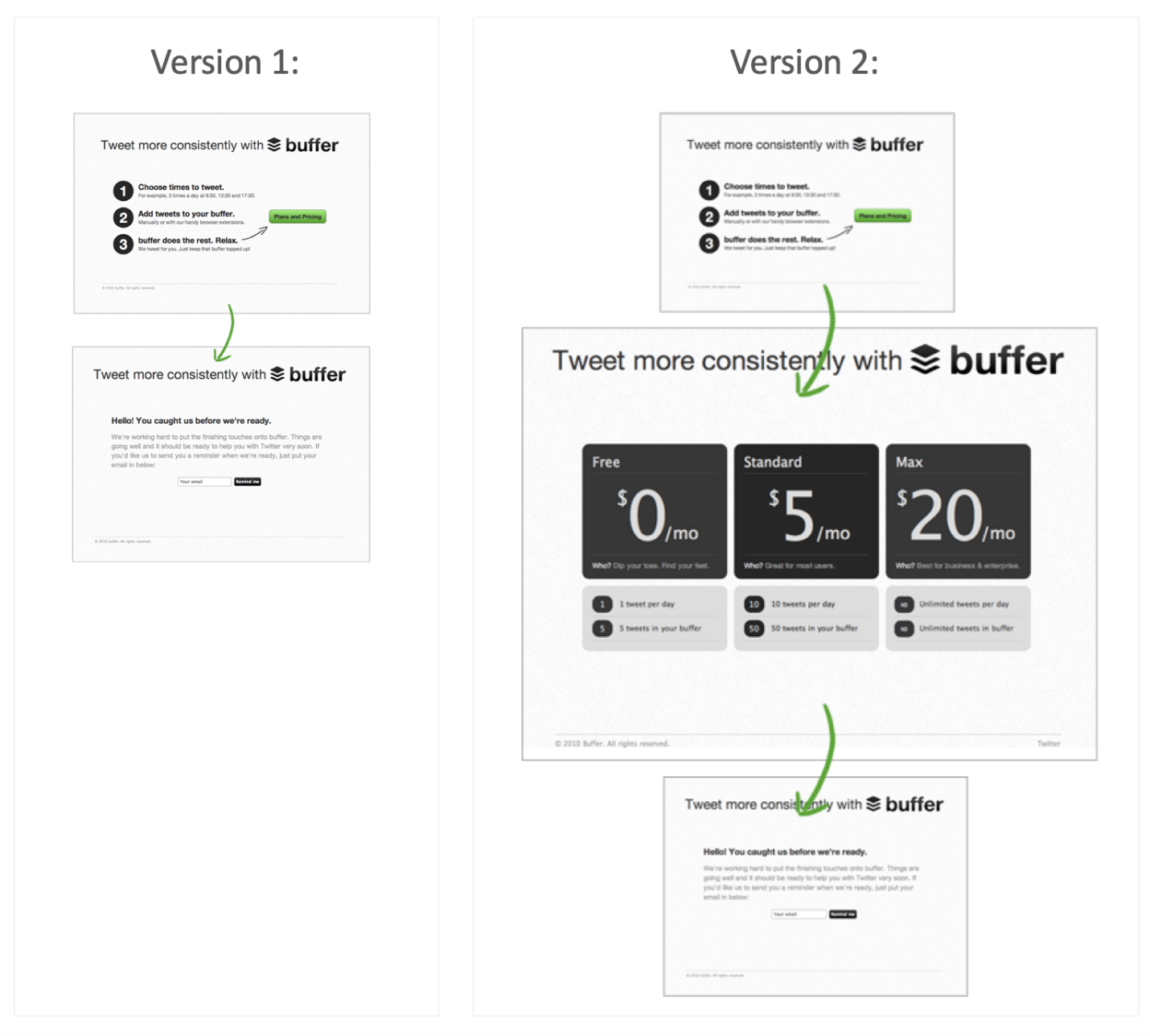
Buffer, an app designed for scheduling social media posts, is an extraordinary example of this. Their MVP was a landing page that explained the platform’s capabilities and encouraged people to sign up. However, by that time the app actually didn’t exist at all so customers were shown a message saying the service wasn’t ready and that they would be receiving updates.
Once the creators had a database of enough possible users, they started asking them if they would be willing to pay for the service. What they did is testing that hypothesis by adding prices to the landing page. This allowed them to see how many visitors would actually turn into paying customers.
2. Short videos (Dropbox)
Short videos are one of the most popular MVPs out there. They are zero-risk, cheap to elaborate, and effective for communicating complex ideas surrounding your product and services. They are so versatile you can post them on MVP platforms such as GoFundMe, show them to investors and even people on your way.
You would be amazed to know that Dropbox, which has a market cap of 11.9 billion, started as a 2-minute MVP that explained with paper figures how the cloud service worked.
3. Ad campaigns and digital mock-ups
Ad campaigns allow you to test if you are targeting the right audiences. With platforms such as Google and Facebook ads, you can even measure what are the features of your products that people appreciate.
Using CGI imagery on your ads is a creative way of testing your product’s appeal. You can do this for a fraction of the real cost of manufacturing a real product by hiring a designer at a platform such as upwork.com.
If people actually try to buy the product once they have reached your website through your social media ads, you can tell them the product is out of stock, and even give them a coupon, a gift card or a discount code they can later use when the product is available. This is great for proving if the market wants the product before you go to the manufacturing process.
A great example of an MVP that started as a crowdfunding project is the board game Kingdom Death Monster, which raised $12.4 million from more than 19,000 people back in 2016. Back then, they used clear images and a great explainer video before they had started production.
5. “The Wizard of Oz”
This MVP consists of creating an illusion of a product, which translates into people thinking they are experiencing the real thing while you are actually using a human resource behind the
curtains. The Wizard of Oz is adequate for analyzing the demand of a product while you keep the operational costs low.
A noteworthy example of The Wizard of Oz is Zappos, a shoe company that was acquired by Amazon in 2009 for $1.2 billion. This business started with its founder Nick Swinmurn posting pictures online of shoes that he didn’t have in stock but that were for sale in stores nearby his home. Once customers bought him a pair of shoes through his simple website he would manually process the order, buy the shoes and send them.
Get directly to your mail the latest trends and news in Software Development, Mobile Development, UX / UI Design and Infrastructure Services, as well as in the management of Dedicated Teams and Turnkey Projects remotely.
Subscribe to our mail and start receibing all of our information.